Author: comms

  • London for Every Child

    London for Every Child

    Guest blog from Hina Bokhari OBE AM

    Leader of the Liberal Democrat Group on the London Assembly

    For more than twenty years I taught in London primary schools, many in some of the city’s most deprived areas. Every day I saw children whose potential was extraordinary, but whose opportunities were shaped by factors completely beyond their control – postcode, poverty, family circumstances.

    Teaching shaped how I see the world. It’s also the reason I entered politics. I wanted to tackle the barriers my students faced that couldn’t be solved in the classroom alone.

    So watching London gradually empty of children feels deeply personal.

    The new report

    Our new London Assembly report shows just how significant the change has been. Between 2013 and 2023, London’s population of children aged 0–9 fell by around 99,000, even as the city’s overall population grew by more than half a million. The decline has been particularly sharp in Inner London.

    We’re already seeing the consequences. Falling pupil numbers are putting huge pressure on schools. Since 2018, around 90 London schools have closed or merged, with more expected in the coming years. But this isn’t just an education issue. When families leave, the wider ecosystem of neighbourhood life begins to unravel – youth services shrink, local businesses struggle, and community spaces disappear.

    The reasons are not hard to identify. London has the highest childcare costs in England and some of the lowest childcare provision for disadvantaged two-year-olds. Housing is another major barrier. Families need larger homes, yet the city continues to deliver mostly smaller flats. Between 2016 and 2025, just 3% of affordable homes built under the Mayor’s programme had four bedrooms or more.

    And then there is the question of space. Too many developments are built without properly considering children – particularly when it comes to play. That is why our report calls for practical action, including mapping every play space in London and developing a London Play Sufficiency Action Plan so we can properly assess whether children actually have places to play in their neighbourhoods.

    We also recommend stronger requirements for family-sized homes in the next London Plan and the creation of a London Children’s Ambassador to bring together policies affecting families – from housing and childcare to planning and schools.

    But while action from City Hall is vital, we should also recognise that London already has powerful community networks that support families. Across the city, faith communities are quietly providing the social infrastructure that helps family life thrive. Churches, mosques, temples, gurdwaras and synagogues host everything from antenatal groups and playgroups to supplementary schools, youth clubs and sports programmes. Many also run mentoring and youth initiatives that help keep young people safe and engaged.

    These spaces are often multigenerational, bringing together children, parents and grandparents. In a fast-moving city where families can easily feel isolated, they create belonging, stability and community.

    But we cannot expect these communities to carry the burden alone. Public sector institutions need to rethink what genuine partnership with them looks like – recognising the expertise and trust community organisations already have and being willing to work alongside them, not simply ask them to deliver programmes designed elsewhere.

    At the same time, faith communities themselves must feel confident engaging with the Mayor, with City Hall, with borough leadership – the very spaces where decisions are made.

    Warning and opportunity

    Our report is both a warning and an opportunity. A warning that London risks becoming a city where fewer families can afford to stay. But also an opportunity to change course – to build a city where children have space to grow, families can put down roots, and communities help shape the future.

    Because a London that works for children is a London that works better for everyone.

    Hina Bokhari OBE AM
    Leader of the Liberal Democrat Group on the London Assembly

  • Renewal and Grievance: LBFN responds to Starmer speech on community cohesion 

    Renewal and Grievance: LBFN responds to Starmer speech on community cohesion 

    During a recent visit to Hastings, Prime Minister Kier Starmer publicly addressed community cohesion in his first real intervention into the issue. He discussed growing divisions in our society, social exclusion, migration, and more. But was it enough? Here, we’d like to give our thoughts on Kier Starmer’s speech and his view of what social cohesion looks like. 

    The PM stressed that “In a world that increasingly prays on weakness, Britain is stronger as a tolerant, decent and respectful country.” He explored the growing divisions and intolerances around migration and acknowledged with pride the crucial role of migration in British history and values. He framed the fight for community cohesion as a fight between ‘grievance and renewal’, between those who say the country is crumbling and those who are hopeful for the future.  

    Some key policies were mentioned in the speech, all aimed at developing a more cohesive community. These include a need for migrants to learn English to combat exclusion, holding charities accountable for hate speech, and releasing funding to give more power and agency to local people in their own communities.  

    Our thoughts 

    While the grievances facing our communities are obvious, the path to renewal remains unclear. It’s good to see the PM’s open acknowledgement of the difficult issues facing those excluded in our society, but the conversation needs to move from the platitudes of just ‘getting along with each other’ to something more pro-active. Are the policies mentioned here enough to create a cohesive, united society?  

    Again, while such policies may move us in the right direction, are the Government’s actions mirroring their words? The UK’s new ‘earned citizenship model’, whereby migrants must prove their worth to gain citizenship, may not be seen to promote the ethos of inclusion and respect that is being claimed here. Conversely, while the new English language requirements for migrants may break down social barriers and aid inclusion, we cannot put responsibility solely on the backs of those being excluded. More must be done to address the growing divisive attitudes some have towards migrants. Ultimately, it is still unclear if this government truly welcomes and values migrants. 

    At LBFN we recognise that hatred, divisiveness, incitement and volatility in public spaces, schools and workplaces is not just about migrants. Cohesive communities are places where everyone feels safe and included; where differences can be celebrated; opinions debated and where attitudes of respect, cultural sensitivity and love for the other are shared by all. 

    Many reading this will undoubtedly agree the crucial role of faith, inter-faith and other community organisations. They should be at the forefront of the overall social cohesion strategy. Much of the attitudes of exclusion present in the UK today are targeted towards specific religious groups, so faith has a central role to play in developing a more inclusive, cohesive society. 

    We are keen to see how the work of the Independent Commission on Community Cohesion develops and we will play our part. But we believe that many of these questions and concerns don’t have to wait for a Commission. Community groups are crucial in developing strategy – but only in partnership with public sector agencies, with strong leadership from central Government. 

    Watch the speech 

    Read the transcript  

    The Independent Commission on Community Cohesion

  • LBFN Newsletter – Sector Activity (March 2026)

    LBFN Newsletter – Sector Activity (March 2026)

    Here you can find a range of resources from the wider sector. This content is part of the London Boroughs Faiths Network bi-monthly newsletter.

    If you would like to get this (and much more) directly to your inbox, sign up at the bottom of this page!

    Measles

    With Measles cases on the rise, it’s important for all Londoners to stay safe.

    In recent years, uptake of the Measles, Mumps & Rubella (MMR) vaccine has fallen. Measles is one of the most highly infectious diseases and spreads rapidly among those who are unvaccinated. It can lead to complications, especially in young infants and those with a weakened immune system, and on rare occasions can tragically cause death.

    We can combat this increase in Measles by staying vaccinated and promoting official vaccine information in our communities.

    Please see the following resources from UKHSA to share with loved ones and your wider communities:

    Holocaust Memorial Day

    Holocaust Memorial Day happened on 27 January, 2026. This is the day to remember the millions of people murdered in the Holocaust under Nazi Persecution. While a difficult time, it is also an opportunity for communities to come together.

    The London Borough of Hackney held an event which remembered various genocides through poetry and prayers, with a child survivor of a Nazi Germany concentration camp in attendance. Excerpts from his brother’s memoir, recounting his experience in a concentration camp, were recited. A tremendous tribute to determination and ingenuity, and a testimony to the power of hope.

    Watch the event in full below.

    Supporting After Emergencies

    The London Communities Emergencies Partnership (LCEP) has created this guide to help you support communities outside of London after an emergency occurs, whether across the UK or internationally.

    Strengthening Partnerships Consultation

    Last year, the Government released a public consultation to strengthen partnership working between emergency responders and Voluntary, Community, and Faith Sector (VCFS) organisations.

    The consultation outcomes are now available.

    Flood Resilience

    What is the Government doing about flood resilience in England?

    This response to a report by the Environmental Audit Committee gives insight into the current state of flood resilience in England.

    Spontaneous Volunteering

    Spontaneous volunteering is an elusive and difficult-to-measure form of volunteering. It is characterised by people who help in times of need outside of formal response structures. This review from London Plus helps us to understand these kinds of volunteers, giving guidance and models to support their safe and effective engagement.

    Faith Security Training

    A new training scheme is available for faith communities in England & Wales. In this training you will learn how to reduce the risk of hate crime, anti-social behaviour, and serious threats.

    London Poverty Map

    Trust for London have created this new interactive map to show what poverty looks like in each London Borough. It includes stats like population, poverty percentage, and more.

    Common ground

    This guidance on social cohesion provides local authorities with the tools to address the challenges they face and share good practice, with the goal of building cohesive communities.

    Public Value of Societal Resilience

    ‘Assessing the public value of societal resilience to disruption’ explores how communities, organisations, and government can better prepare for and recover from disruption.


    Event: HPV & Cancer Prevention for Faith & Community Leaders.

    11/03/26

    These sessions will explore how faith values relate to health and care, how faith leaders can support trusted, culturally appropriate health messaging, and more. There are upcoming roundtables for Catholic and Sikh leaders. Find out more below.

    Event: Trusted Youth Allies

    Multiple dates

    Equip yourself with the skills to support young people who have been victims and witnesses of crime. These events are happening throughout March.

    Event: Self-Initiated Terrorism Presentation

    11/03/26

    This webinar will highlight some of the behaviours which may present by someone who is a Self-Initiated Terrorist. By increasing awareness and understanding this can assist police to take action before they go on to commit an attack.

    Event: Ready Together

    17/03/26

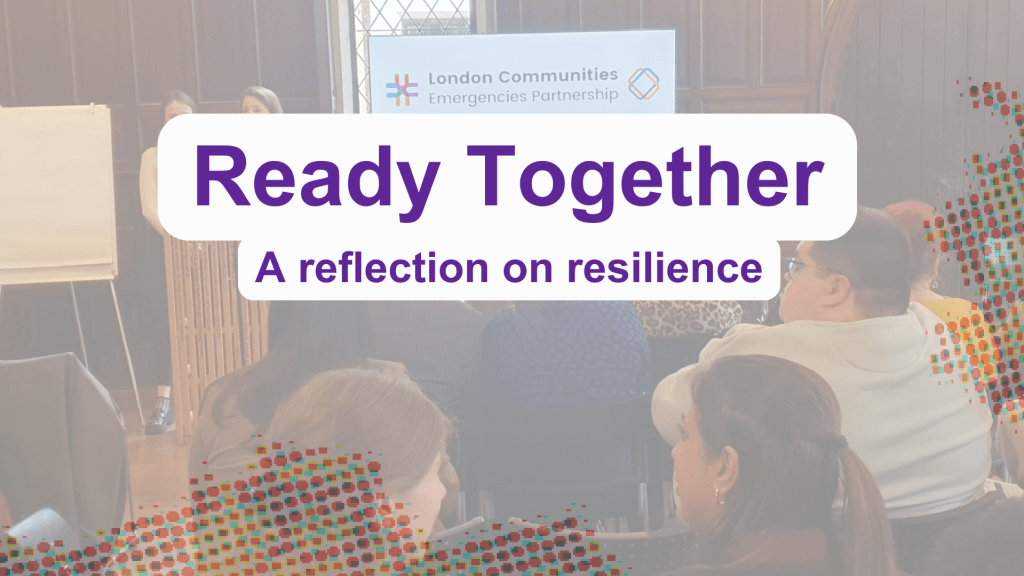
    The London Communities Emergencies Partnership’s Ready Together 2026 event brings partners together to strengthen London’s community resilience through awareness, connection and knowledge. It’s a full day of talks and workshops and is completely free! The event is nearly sold out and LCEP will be operating a waiting list.

    Event: Active Bystander Training

    19/03/26

    Find out what to do if you witness identity-based harassment or violence with this training from Protection Approaches. Only a few tickets left for this one. Also see this list of ‘Stand up Against Harassment Training‘ from The Suzy Lamplugh Trust.

    Event: Adverse Weather

    26/03/26

    UK Health Security Agency (UKHSA) will host this webinar on the Adverse Weather and Health Plan 2025-2026. The webinar will include an update on the plan as well as next steps.

    Community Preparedness Day

    14/04/26

    This is a day of networking, workshops, presentations and collaboration with key partners in the emergency sector. The event is led by THCVS with support from Hackney CVS, the Volunteer Centre Tower Hamlets and the Equalities Network.

    Great Get Together

    19-21/06/26

    The Great Get Together is inspired by Jo Cox’s belief that we have more in common than that which divides us. This year, the annual event marks 10 years since the murder of Jo Cox (MP). This anniversary is not just about remembrance. It is a moment of choice. Holding a Great Get Together in your local area is a simple but powerful way to honour Jo’s legacy and show what community really means.


    Links from the National Youth Strategy event

    Please find more information about this event on the LBFN March 2026 newsletter.

    Youth work curriculum: a flexible framework which allows youth workers to identify how their interventions and activities can be used to support the personal, social and political development of young people

    Local Authorities Statutory Duty: Local Authorities have a duty to secure, so far as is reasonably practicable, sufficient provision of educational and recreational leisure-time activities for young people in their area.

    Local Outcomes Framework: This includes a youth metric around participation in youth services in the last 12 months (including sports, music, art or youth clubs)

    Youth voice guidance: The guidance provides a step-by-step introduction to reasons, methods and approaches for engaging young people in policymaking.

    “Are You Listening?”: Jack Petchey Foundation youth survey report youth Survey report

    Partnership for Young London Weekly Update

    Network and Training Offer: Access to London Youth’s Networks

    London’s youth VCS data tool: based on London Youth’s membership data

    Mapping tool: Estimate of 1,800 voluntary and community youth organisations delivering youth work in the capital

  • Active Bystander Training

    Active Bystander Training

    Combatting identity-based harassment and violence is vital for increased resilience in our communities. London is a diverse space for all, protecting those who fall victim to this kind of abuse is more important than ever.

    Protection Approaches are hosting a very important Active Bystander Training session alongside London Plus!

    This training is completely FREE and will teach you everything you need to know to safely address identity-based violence in your community.

    The training is happening on January 20, 2026 – sign up for free now!